MNMiss North Maths
GCSE Foundation › Probability

Probability

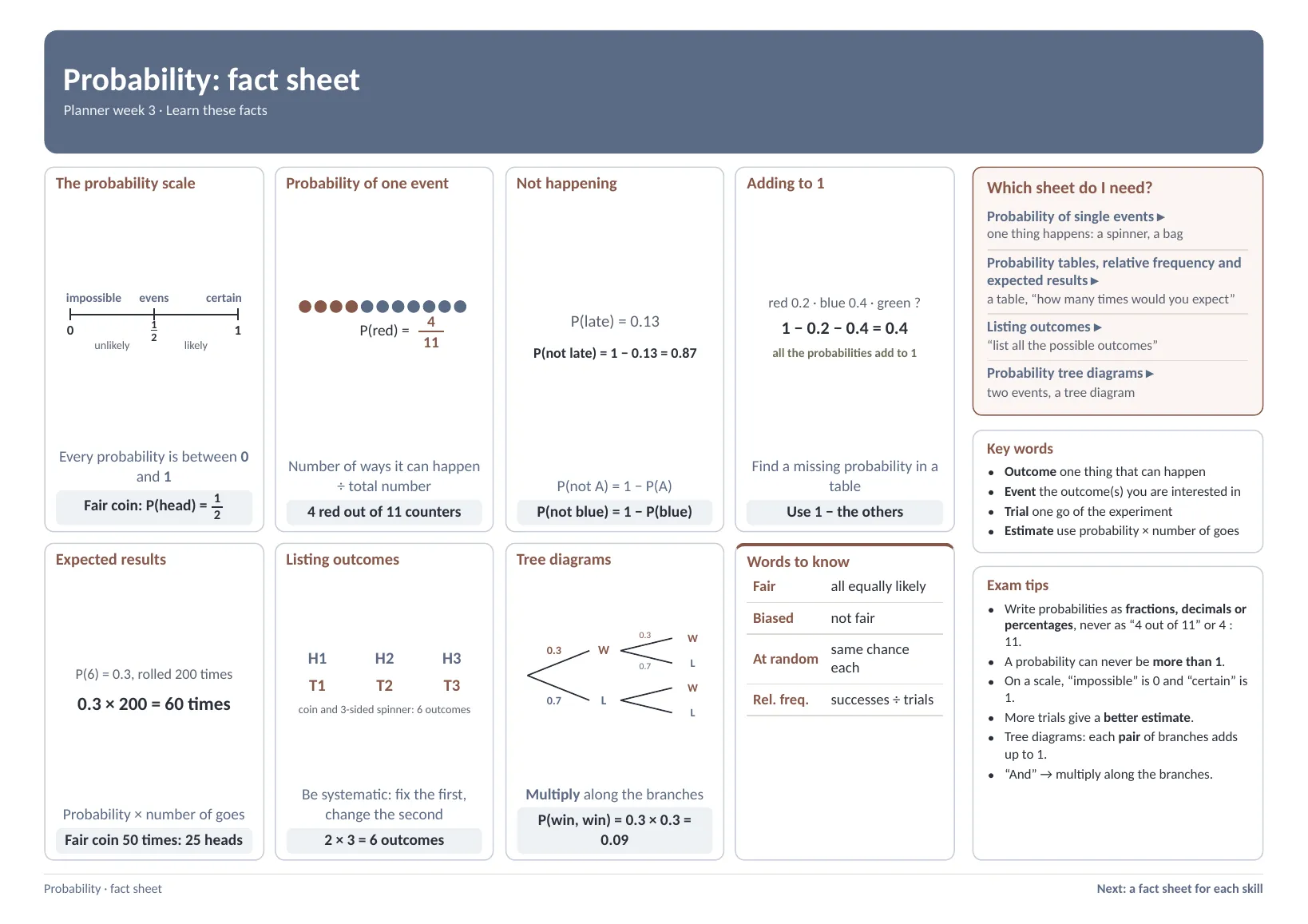
The probability scale, probability of one event, "not happening", tables that add to 1, expected results, listing outcomes and tree diagrams. On your revision planner in week 3.

1. Watch

Miss North: Probability. Pause the video when it says, and try the questions yourself.

2. Learn the facts

Probability fact sheet: Overview
1 of 5 · OverviewTap the sheet to open it full size
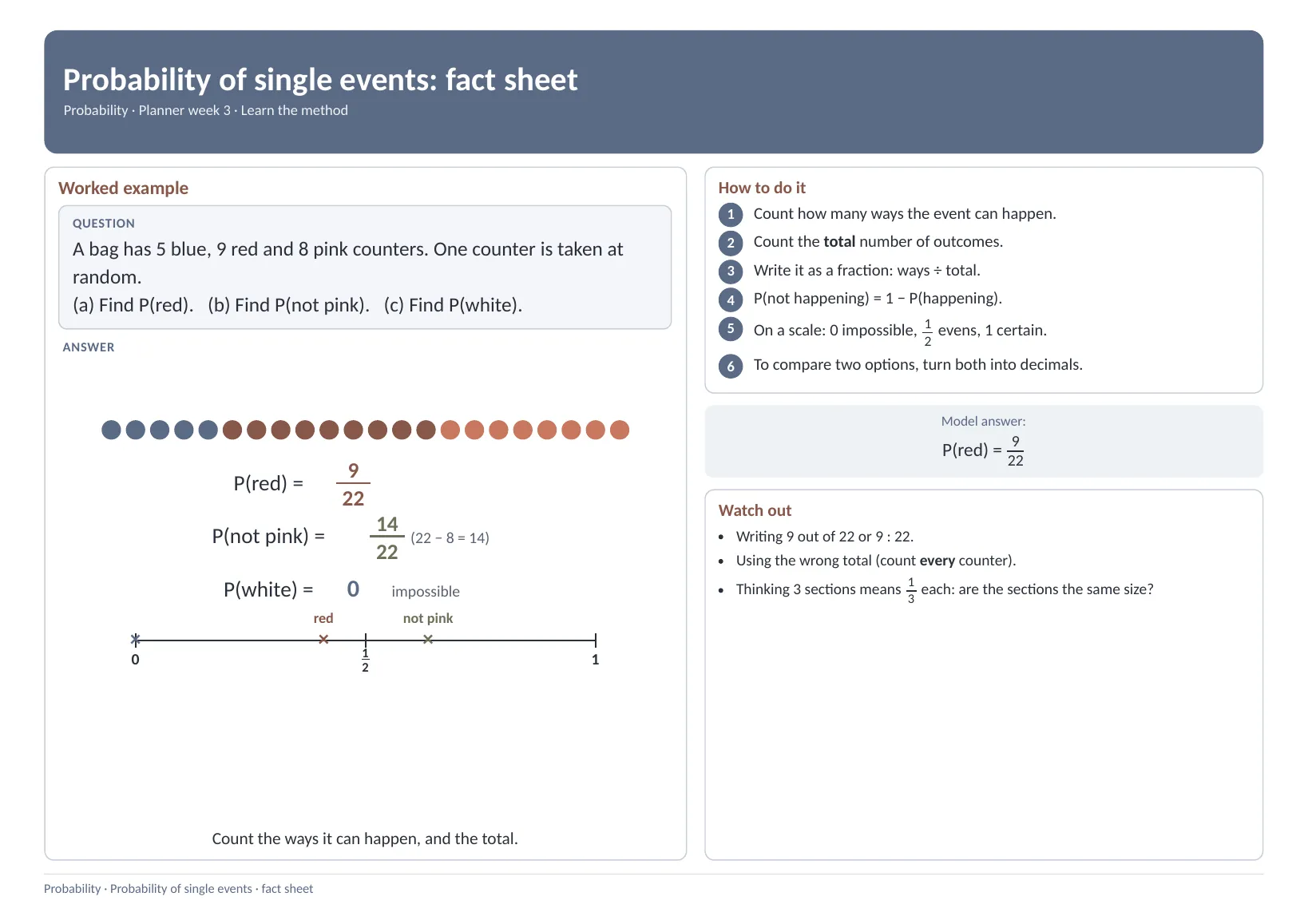
Probability fact sheet: Probability of single events
2 of 5 · Probability of single eventsTap the sheet to open it full size
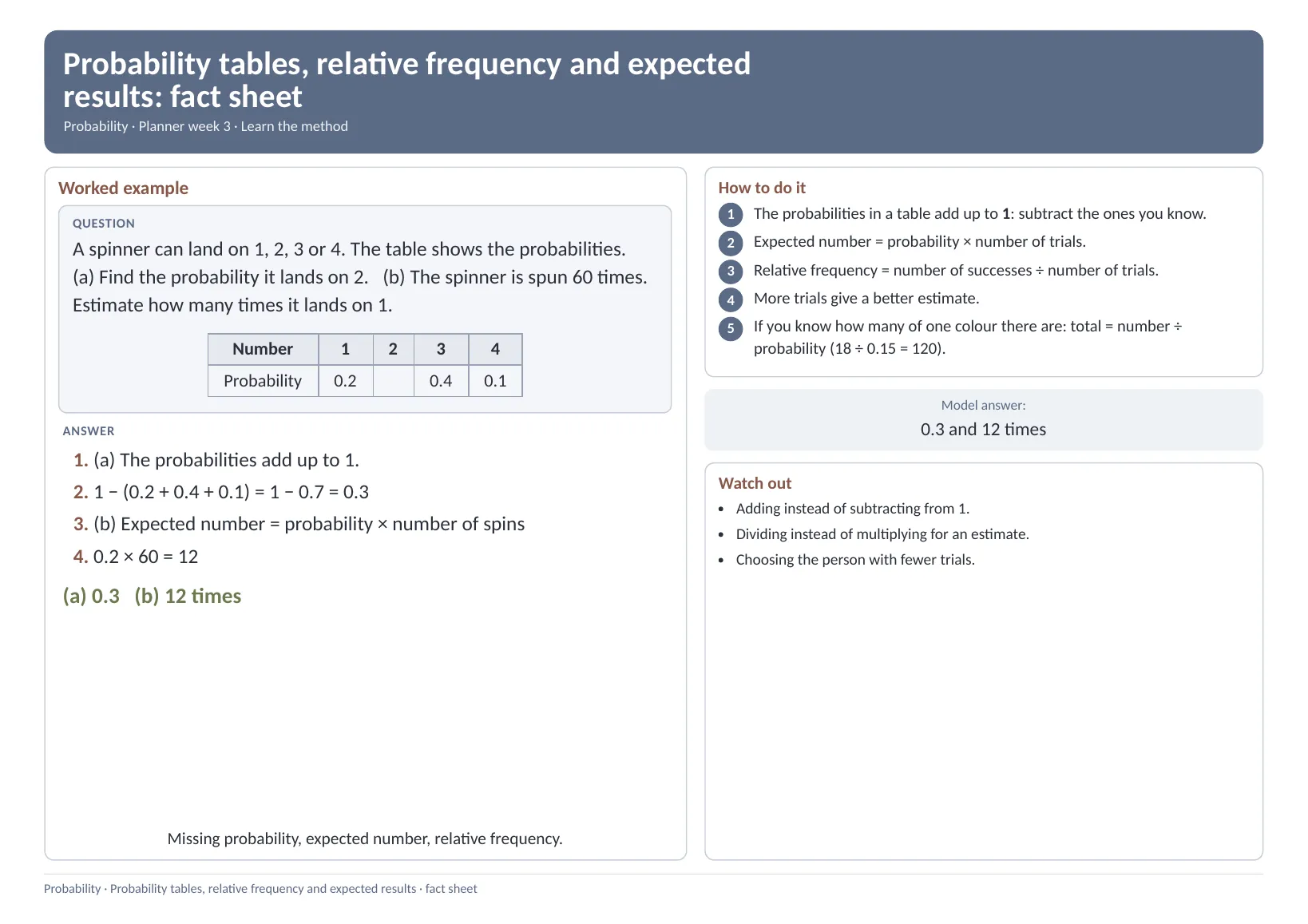
Probability fact sheet: Tables, relative frequency and expected results
3 of 5 · Tables, relative frequency and expected resultsTap the sheet to open it full size
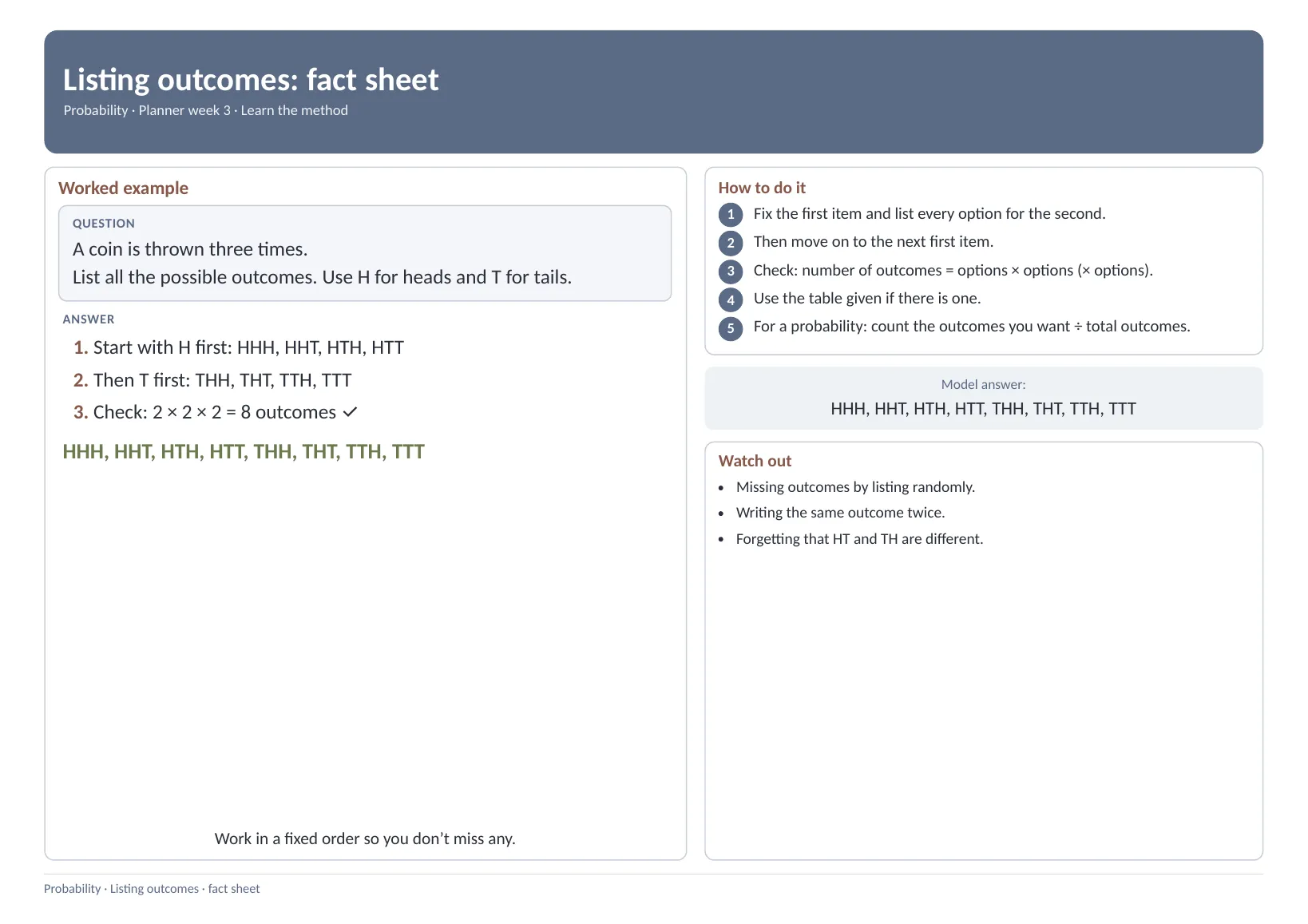
Probability fact sheet: Listing outcomes
4 of 5 · Listing outcomesTap the sheet to open it full size
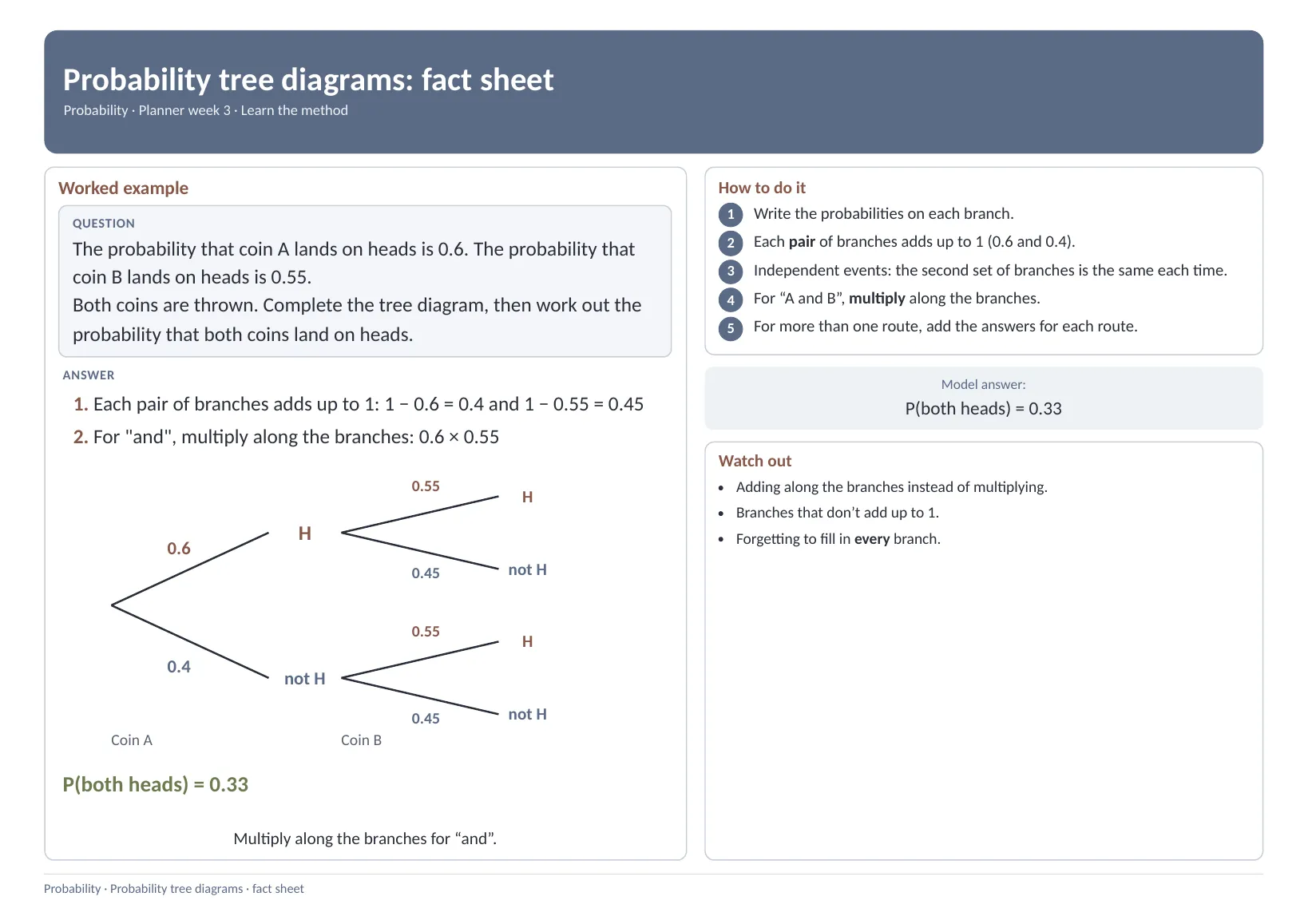
Probability fact sheet: Tree diagrams
5 of 5 · Tree diagramsTap the sheet to open it full size

3. Practice questions

Try each one on paper first, then check. These are from take-home sheet Revision 10 (Probability and averages).

Your score: 0 / 12 marks
1
Grade 1Non-calculator2 marks

A bag contains 4 red counters, 9 blue counters and 3 green counters. A counter is taken at random.

(a)Work out the probability that the counter is blue.(1)
(b)Write down the probability that the counter is yellow.(1)
Show the answer
(a) 916   (b) 0
B1 916 or equivalent · B1 0
Watch out: (a) Writing 97 (blue compared with the rest). The bottom is the TOTAL, 16. (b) 'Impossible' is fine in words, but a probability is a number: 0.
2
Grade 2Non-calculator3 marks

The table shows the probabilities that a spinner lands on each colour.

ColourProbability
Red0.46
Blue0.19
Green0.09
Yellow

(a)Work out the probability that the spinner lands on yellow.(2)
(b)Work out the probability that the spinner does not land on blue.(1)
Show the answer
(a) 0.26   (b) 0.81
(a) M1 1 − (0.46 + 0.19 + 0.09) · A1 0.26 · (b) B1 0.81
Watch out: Subtracting from 100 (probabilities as decimals add up to 1), or lining up the decimals wrongly: 1 − 0.7 = 0.3, not 0.03.
3
Grade 2Non-calculator3 marks

Tom chooses one colour and one item.
Colour: red, blue, black, white.   Item: cap, hat.

(a)List all the possible combinations.(2)
(b)Tom chooses at random. Work out the probability of black with a hat.(1)
Show the answer
(a) red cap, red hat, blue cap, blue hat, black cap, black hat, white cap, white hat   (b) 18
(a) M1 at least 3 correct · A1 all 8 and no extras · (b) B1 18
Watch out: Missing some (or repeating some). Be systematic: there are 4 × 2 = 8.
4
Grade 3Non-calculator2 marks

The probability that a biased coin lands on heads is 0.95. The coin is thrown 140 times. Work out an estimate for the number of times it lands on heads. (2)

Show the answer
133
M1 0.95 × 140 · A1 133
Watch out: Dividing (140 ÷ 0.95) or giving the probability. Multiply: 0.95 × 140.
5
Grade 4Non-calculator2 marks

A bag contains red, blue and green counters only. A counter is taken at random. The probability that it is red is 0.58. A blue counter and a green counter are equally likely. Work out the probability that the counter is green. (2)

Show the answer
0.21
M1 1 − 0.58 (= 0.42) · A1 0.21
Watch out: Stopping at 1 − 0.58 = 0.42. That is blue AND green together: halve it.

4. Quiz yourself

The Blooket for this topic is coming soon.

5. Print it

The whole probability fact sheet as a PDF, 5 pages, ready to print or keep on your phone.

Download the fact sheet (PDF)